
It’s the year 2020. The worlds knowledge is a search away, cars can drive themselves and our phones are super computers.
Despite this, most built environment engineers still use pencil and paper, a few spreadsheets, Microsoft Word and PDF.


There are quite a few engineering analysis programs of course. Although contrary to the perception, there are many engineers who don’t actually use them much. Only a small part of engineering is calculation after all. Project engineers for example spend all their time on programme, procurement and going to meetings. Even design engineers spend most of their time creating documentation rather than crunching numbers.
It’s no secret that this industry is slow to adopt technology. But is there actually any new tech that can change engineering? And are there ways you could use it to outperform traditional engineers into the future?
Here we outline some clear trends where skill in modern tech could differentiate you from typical engineers working today.
Modelling is taking over from 2D drawing
Traditionally, engineers have communicated design through sketches and drawings. In current practice though, engineering drawings are slowly being replaced by models. These are usually referred to as BIM or Building Information Models or increasingly digital Twins.

Evidence of this change happening include:
- It now being common for models to be shared directly between designers without waiting for drawings to be produced.
- To speed up programme, fabrication models are commencing based on Work In Progress design models without drawings.
- There have been projects where no drawings are produced at all. For these, site workers are discouraged from using printed plans and rely on tablet computers to locate design elements and even lay out reinforcement.
So how can you use this to your advantage?
Despite the clear trend towards model use, many engineers today do not know how to work with models well. Understanding how to use and create them is therefore a huge advantage.
Some skills useful for this include:
- Navigating models in Revit (including cutting sections, using filters and extracting geometry)
- Editing in Revit (including changing member sizes and drawing details)
- Knowing how to use Rhino and grasshopper
- Converting models between different formats
- Sketching in 3D for connection details and reinforcement
Automation is making design faster
Every year, the time allowed for engineering design is being reduced. This is often called accelerated programme or is simply being directed to use preliminary documentation to start later stages early.
One way engineers can adapt to this new environment is to get assistance from Automation. The simplest and common way engineering calculations have been automated in the past is through spreadsheets – which is a lot quicker than pencil and paper.
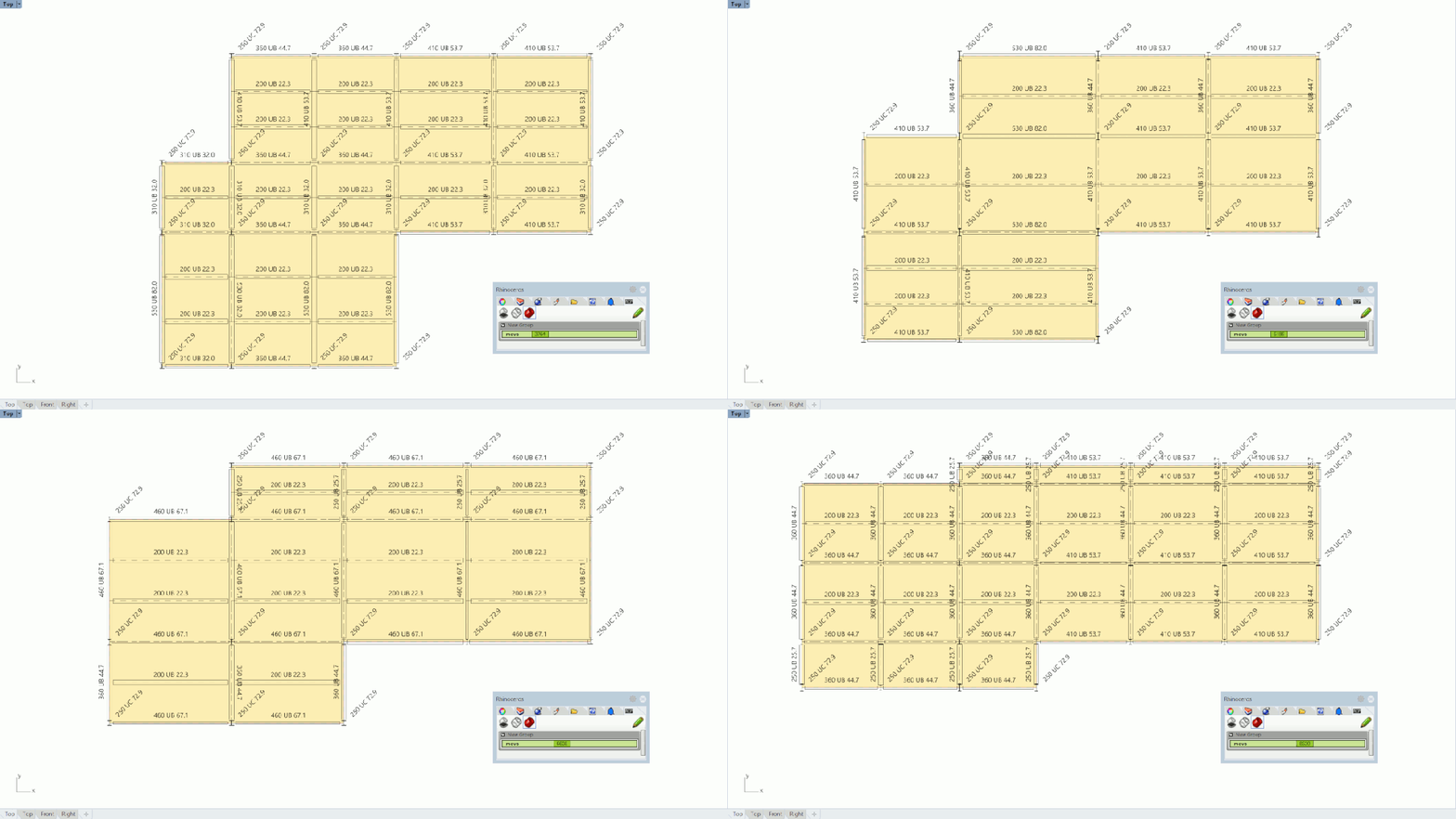
These days however, producing sketches, drawings and models can also often be automated through technology such as parametric design. This technique relies on a set of rules for creating building elements formed into a script. For example, a script could draw structure (beams and columns) based on the input of architectural geometry. The advantage of this is that when the geometry changes, the building elements automatically update to suit.
Generative design for engineers often means going a step further with a script of rules so that the computer can actually design itself. Instead of just rules about geometry, the script could specify maximum stress that a material can support so that it can try many iterations and determine where material should be located for maximum efficiency. Using this process can often lead to organic type shapes such as the one below. It is still early days for this technology however but one that is likely to have a bright future.

Skills in parametric design and generative design include:
- Understanding how to use Grasshopper
- Understanding how to use Dynamo (for Revit)
- Fusion 360 and Revit for Generative Design
Future Building Technology
Not all technology changes relate to engineering design and documentation. Another area where modern engineers can outperform others is in knowledge of future building technology and trends.
One trend that is clearly gaining more excitement in Australia and other countries is modern engineered timber design. Engineered timber has been slow to catch on for many years partly because the industry was so unused to it and partly because of the difficulty of sourcing modern timber materials such as CLT and Glulam. In the last few years however, engineered timber product technology has increased and they have become more readily available. Also, there are now several sources of modern timber connection detail fittings which allow robust, standard and hidden joints. As a result, Architects and builders have become excited to design with timber in larger scale buildings.


Timber has different engineering challenges when used at scale than traditional steel and concrete. Engineers who become experienced in designing with it are likely to become sought after in the future.
Another major trend in building design is towards more environmentally sustainable solutions. Design goals such as Greenstar can mean reducing use of materials with some being more critical than others (such as concrete which has a high carbon footprint). Lightweight structures and timber can help with these aims.
Other goals like ‘Passive House’ are more of a concern for services engineers but do have implications for structural engineers as well. Passive house directs designers to have an insulated envelope around a building. This can mean that foundations only have limited contact with the ground for example.

Sustainability is a huge factor in modern building design. A knowledge of the engineering implications of this trend in your discipline is well valued already and will be more so in the near future.
Take Away
Whether its in modelling or automation for documentation or in future building trends such as timber or sustainability, technology is having an impact on engineers. Gaining an understanding of how to work with these new techniques should give future engineers an advantage over the traditional approach especially because change can be slow to be adopted in the industry.
If you liked this post and wanted to find out more, please visit www.structuredparametrics.com.
 Structured Parametrics