While it seems logical to use the modelled geometry in analysis models for other purposes (such as BIM), it is currently not common practice. Some of the reasons for this are described in this post and why they can be overcome.
1. It’s too hard or is not worth the time for the size of the job
For very small jobs modelling time for each program is short so it’s clear that conversion will not be worth the time. As models get larger however, replicating the modelling effort takes more time, can introduce differences between models and implementing changes becomes increasingly significant.

There’s no doubt that conversion between models has always been hard in the past due to the many different programs used and the multitude of file formats.
That’s why the idea of a conversion service is so valuable. It takes the time and the difficulty out of the task, freeing up resources for other important work.
2. There is software that converts but it doesn’t do X
Over the years, the problem of converting information between models has never fully been solved. Each year, software companies provide plugins or export options for a myriad of formats which attempt to provide help. While these solutions work in some cases, there are often limitations which prevent them being practical in delivering useful output including:
- Elements being missed in the conversion for certain types
- The conversion cannot be updated without a full model replacement
- The conversion is one-way only so that information cannot be fed back
- The solution isn’t compatible with non-standard or custom sections
- Attributes are not addressed such as top of steel levels or orientation
- The solution is not compatible with newer or older versions of files
For these and many other reasons, using a service rather than software solution means you can focus on getting the work done rather than dealing with transfer problems and allows ongoing flexibility.
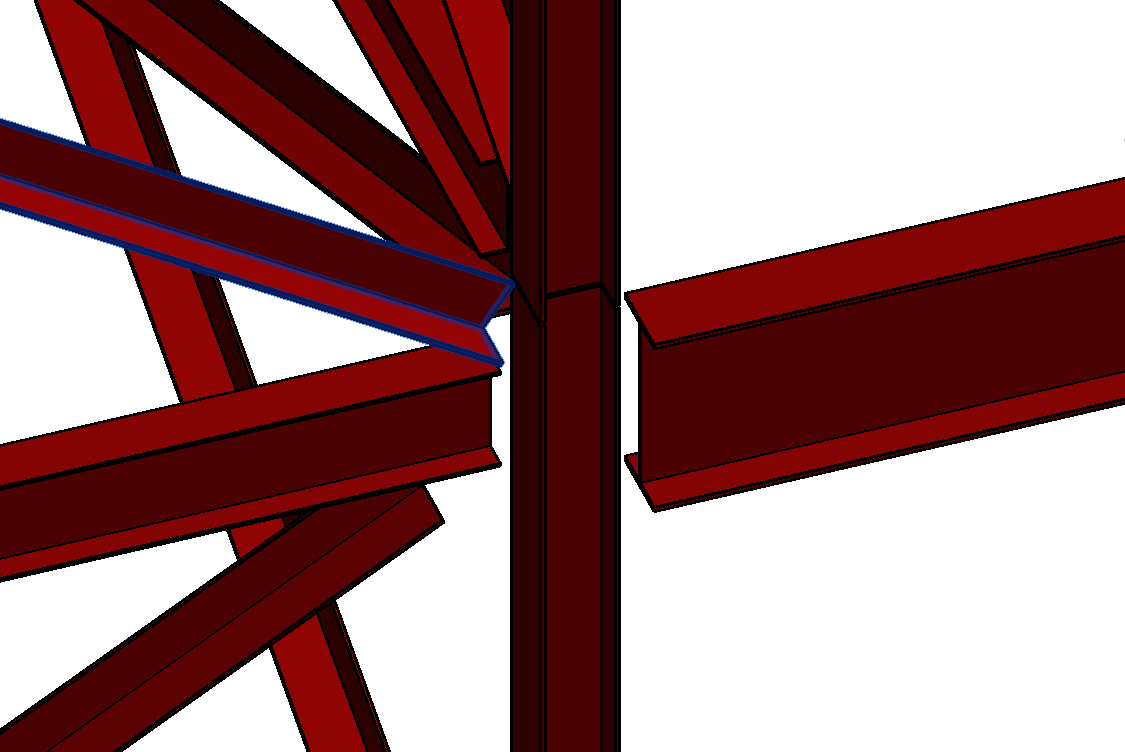
3. Nodes and other modelling looks wrong
These images show the difference between an poor and improved conversion. In the first image, the BIM model does not know that columns should be continuous and that bracing should stop short from the connection.


Our converted models address the level of detail required for a quality model. We understand the needs of the BIM deliverable based on experience of its intended use.
4. When updated, the BIM model loses tags and other information
Often when models change, it is difficult to re-import the updated information into the BIM model without losing tags or other drafted information. This is why it is common for the ‘smart link’ to be broken half way through a project.
We use a managed process that implements incremental change but does not alter previously placed members.
There should be no need to have to re-do drafting work that has already been done.


5. Top of steel, orientations and other attributes are wrong
This is a common problem for basic conversion techniques. Most analysis models will use centreline geometry, which if converted with simple techniques will result in the image on the left. A good conversion will correctly replicate the the steel work orientation and top of steel levels.


6. The members cannot be edited or are not the right format to edit
This is also common for conversions undertaken with a simplified process. Sometimes elements are converted as mass objects or the wrong type of element for the drafting package.

Our process ensures members are brought in as the correct type for your workflow. Elements are brought in as families in Revit and can be manipulated after conversion.
7. The Analysis model is less accurate than the drafting model
Generally, a more accurate model will have better design outputs. Despite this, the analysis model can often be a simplified representation of the real geometry due to either time constraints or difficulty in modelling shapes in particular software.
With modern conversion techniques however, there is now no need for the model to be simplified for either of these reasons. It is now much easier to convert the geometry into an accurate analysis model than create a representation by hand.
8. The Analysis model doesn’t need all the extra information the BIM model needs
The analysis model does not need all the information that a BIM model will require because it is either not designed for it or it adds needless complexity. It often does not have footings, stairs or secondary steel for example. Despite this, in many cases a conversion of the primary frame (being the bulk of the work) is a very helpful and time saving process and is an easy time saver that should be considered.
For more information on how we can help, visit www.structuredparametrics.com
 Structured Parametrics