Models are increasingly becoming central to engineering workflow and in some cases are even the main deliverable as we move towards a digital future.
It is currently common for many models of the same building to be created throughout design, each with a different purpose and using different software. These can include:
- Architectural models
- Analysis models
- Structural and Services drafting models
- Shop drawing models
While each of these models in theory have the same geometry, they are usually built manually from scratch in the specific format required. This hand crafted process can be very time consuming.

There are also many changes made during design development requiring updates to the multiple models required. In replicating the changes, it is challenging to avoid errors and models can lag behind due to time constraints.
A whole process of clash detection has been developed to mitigate this process which is time consuming in itself.
To visualise the process, a simplified diagram with two rounds of change is shown below as an example. The drafting waits until the sizing is confirmed by the engineer:
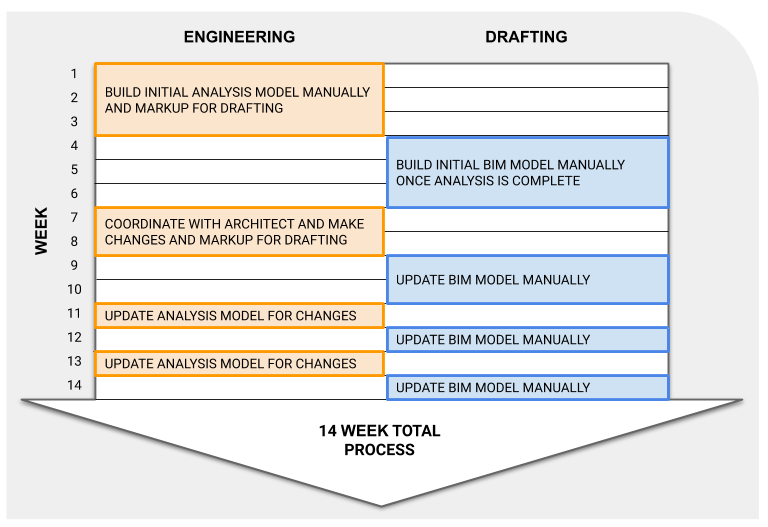
Can this process be improved?
As the geometry should not differ, it makes sense to share that information where possible between models. Using model conversion has the following advantages:
- Less manual work. With geometry accurately reflecting the original, each modeller can focus on specialist information needed for the models purpose (for example analysis or drawing production).
- Less errors in accuracy due to repetition of information in different formats.
- The drafter does not have to wait for the Engineer to provide markups.
- When changes are required, replication across models is quicker and more accurate.
A workflow using model conversion might look like this:

Time savings can be used to optimise the design and/or allow quicker response to clients.
How can model information be shared?
The industry currently shares model information with a few methods:
- Software specific tools. Large analysis or BIM programs sometimes provide additional software tools to allow one way or two way interchange. This is dependant on your software provider.
- A neutral file format. Efforts are being made to standardise around a file format such as IFC. While progress is being made with this, many believe we are not at a stage reliable enough for delivery yet.
Why is model information not shared more commonly? Probably because the current methods have several limitations (which I will not cover here). Suffice it to say that many see interoperability as an ongoing pain point for the industry which will only become more acute as models increasingly become the main deliverable for Engineers.
Structured Parametrics hopes to help in some way and has a structured service that can provide model conversion with a quick turnaround time.
For more information, visit www.structuredparametrics.com
 Structured Parametrics